Welcome to the fourth edition of City Center Watch, my monthly-ish roundup of city-center news from the Nordics and around the Baltic Sea.
Let’s dive right in.
Follow City Center Watch
Subscribe to receive new editions of City Center Watch directly by email.
1. Lübeck turns experimentation into a more permanent way of working
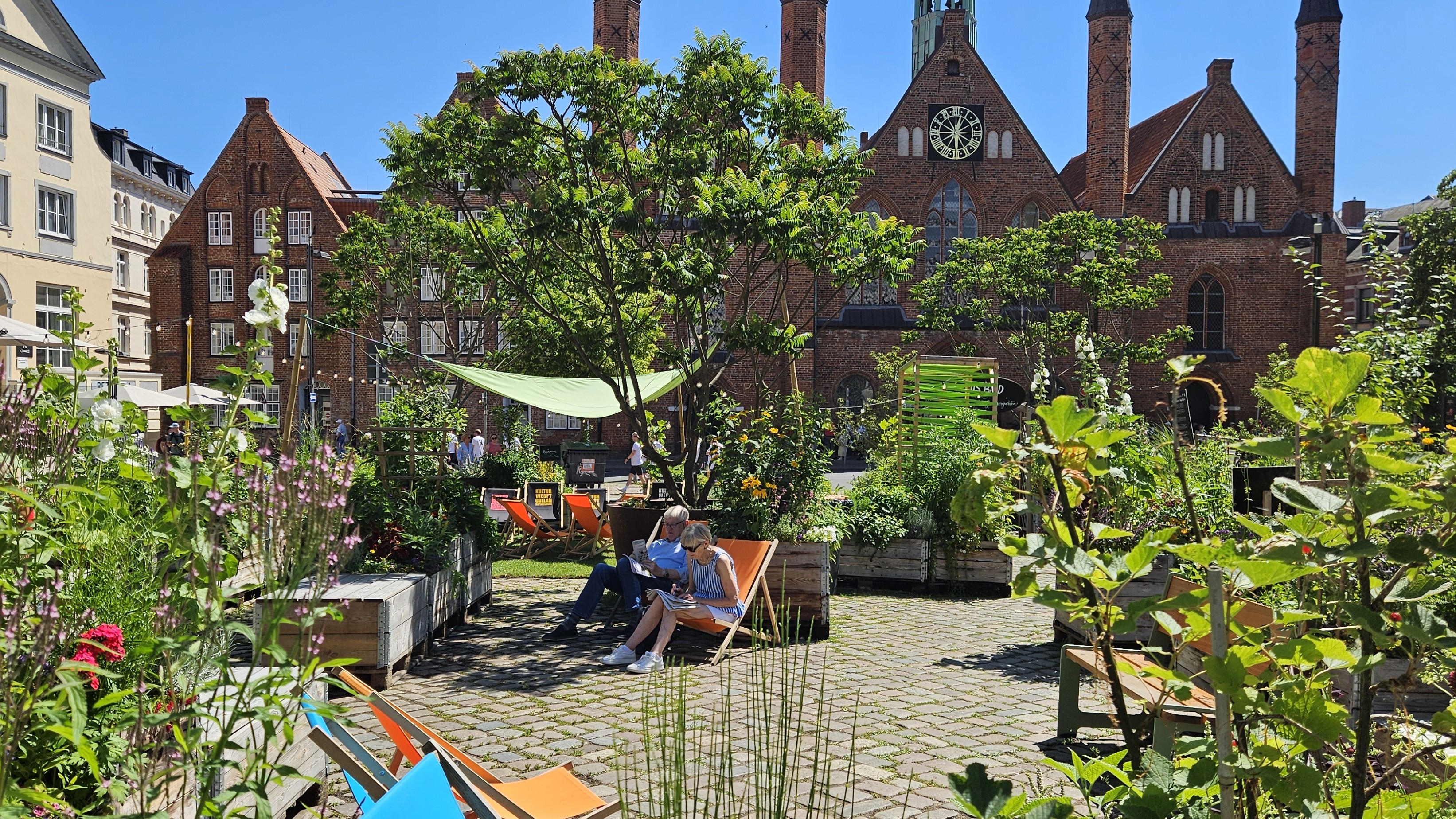
I visited Lübeck in July and came away impressed by how much experimentation was taking place in its historic center. I particularly enjoyed a temporary summer garden occupying part of a central square. The former Karstadt department store was also being prepared for a new life as the Bildungshaus, bringing education, culture and public activities into a building that had lost its original commercial purpose.
Much of this grew out of ÜBERGANGSWEISE, a three-year city-center program backed by around €5 million from Germany’s federal government. Lübeck used the funding to test temporary uses for vacant properties, new activities in public spaces and different ways of bringing businesses, property owners, cultural actors and residents into city-center development.
The federal funding ended in November 2025, so my summer visit offered a glimpse of what was continuing beyond the funded period. Some temporary uses had already found a more lasting footing. The city’s review of the program describes how a yoga studio and other occupants continued with their own leases.
Now Lübeck has published an action plan for what comes next. Its 16 measures range from matching vacant premises with new users to developing new retail concepts and stronger partnerships with local businesses. The aim is to share responsibility for the center more broadly between the municipality, businesses and civil society.
I find that shift particularly interesting. National funding can make experimentation possible at a scale that local actors might struggle to finance on their own. But government programs come and go as political priorities change. Local businesses, property owners and other actors have a continuing stake in keeping their city center alive.
Building cooperation around that local commitment makes sense. For Lübeck, the challenge now is to turn shared interest into commitments of time, money and responsibility that can keep the work going.
2. Tallinn brings a new reason to visit the waterfront
This one is particularly nice for me to see. In my previous work I was involved in advancing the idea of bringing the Allas Pool concept to Tallinn, and in August the project finally received its building permit.
The approximately €25 million complex is planned for Kalasadam beside Linnahall and will bring outdoor pools, saunas, restaurants, terraces and event spaces to Tallinn’s central waterfront. Designed to operate throughout the year, it is currently scheduled to open in 2028.

For Tallinn, the project matters beyond the pools themselves. Large parts of its central waterfront were long occupied by ports, infrastructure and other uses that kept people away from the shoreline. The project includes the reconstruction of the quay and a new publicly accessible promenade, continuing the gradual opening of the coast and pulling city-center activity toward the sea. The promenade would also give people somewhere to walk and spend time by the water without entering the bathing complex.
It adds another kind of reason to visit the center, too. As the role of shopping changes, city centers increasingly depend on a broader mixture of recreation, culture, food and opportunities to meet. People can combine several of these within the same visit. A swim might become an afternoon that also includes a meal and a walk along the waterfront. The year-round pools and saunas would also add to the center’s appeal during the colder months.
Its Helsinki relative, Allas Pool Helsinki, has become one of those places where locals and visitors mix. You can swim before work, meet friends in the sauna or find yourself sitting beside somebody visiting Helsinki for the first time. Hopefully its Tallinn cousin can develop some of that same quality.
3. Aarhus’s new offices raise questions about the old ones
Office space advertised for lease in central Aarhus has almost quadrupled in just three years, rising from roughly 36,000 to 132,000 square meters, according to property adviser Nordicals. That is an unusually rapid increase for a city-center office market.
The forces behind this are familiar in many cities. Changes in work, workplace expectations and competition for employees are pushing companies toward modern, high-quality offices in attractive and well-connected locations. In Aarhus, however, several large developments have brought substantial amounts of new space onto the market within a short period. Supply has grown faster than the market can absorb it, giving companies looking to relocate within the city or establish themselves there plenty of choice.
That investment can strengthen the center’s appeal as a place to work and do business. Employment has continued to grow, and new buildings are attracting tenants. But some of those tenants are existing companies moving out of older premises elsewhere in Aarhus. Their moves leave buildings behind that may struggle to compete with what is now available.
The location of that older stock matters. Buildings in central areas can have opportunities for housing or other uses because the location itself remains attractive. The same changes that leave an office struggling to find tenants could therefore create an opening for a different kind of investment in the center.
Converting an office building into apartments is rarely as easy as drawing new walls on a floor plan, though. Planning rules, building depth, daylight, noise and economics can all get in the way. Some buildings will be much better suited to conversion than others.
Where adaptation is possible, Aarhus could gain more people living in its center alongside better places to work. That could also bring more regular customers to nearby shops, restaurants and services, giving the office-market changes a wider significance for everyday city-center life.
4. Helsinki prepares for a city center under construction
Here in Helsinki, plans for a major overhaul of Rautatientori metro station have been moving forward. The roughly €125 million project would renew technical systems, passenger facilities and commercial spaces across six underground levels. Plans include closing the station to passengers for around six months, while trains would continue through without stopping.
On its own, that is already a major project. But I find it more interesting as the opening chapter in what is set to become several years of unusually intensive construction in central Helsinki.
Some of this work is unavoidable. Aging infrastructure beneath Kaivokatu, in front of the main railway station, and the streets around Esplanadi park needs to be renewed. Growing tram traffic also requires changes to important transport corridors. Considerable effort has already gone into figuring out how to phase the metro overhaul, Kaivokatu reconstruction, West Harbour light rail and later works around Esplanadi. Several projects will overlap, and keeping the center functioning through them will be a demanding task.
There is broad agreement across the city and its companies that these works will require unusually close coordination. People need clear routes to shops, workplaces and public transport, while businesses need workable deliveries and reliable information about changing arrangements. Streets will be dug up and journeys will sometimes become less convenient, but the ambition must be to keep disruption to everyday city-center life as limited as possible.
The investments also create opportunities that go well beyond replacing worn-out infrastructure. Some of Helsinki’s most important streets can become greener, more comfortable for walking and better suited to growing public-transport use. Together, these improvements could strengthen the vitality and attractiveness of the center as a whole.
Getting there will take years. Keeping the center accessible, lively and worth visiting throughout the works will be part of making that transformation succeed.
5. Vilnius plans a new district within reach of the center
Vilnius and Lithuanian Railways are preparing an international urban-development competition for around 55 hectares of railway and industrial land south of the existing center. The area is currently dominated by tracks, warehouses and other railway functions, and the ambition is to gradually turn it into a mixed-use district with housing, workplaces, services, public spaces and greenery.
The site lies beyond the established center, which is part of why I think it belongs in City Center Watch.
The vitality of a city center is not determined only by what happens inside some agreed boundary around it. It also depends on what surrounds the center and, especially, on how many people live within easy reach of it.
That becomes increasingly important as daily life changes. Remote and hybrid work reduce the need to commute to a central workplace every weekday, while many everyday services can now be accessed digitally. For people spending more of their working week at home, nearby shops, services and meeting places can take on greater importance. More residents within walking, cycling and public-transport distance give the center a larger nearby population that can make it part of everyday life.
Railway and industrial sites becoming available for redevelopment are particularly valuable in this respect. They offer substantial amounts of centrally located land where entirely new neighborhoods can still be created.
In Vilnius, the competition is also intended to improve connections between neighborhoods currently separated by railway infrastructure. Better routes could bring existing residents within easier reach of the center as well, extending the benefits beyond the redevelopment area itself.
Sometimes strengthening the city center means building inside it. Sometimes it means giving many more people the chance to live next door to it.
Also on my radar
Turku — a new riverfront block combines density and urban quality
Turku has approved the Herkules plan, bringing homes for around 350 people, workplaces and services to a largely parking-covered site beside the Aurajoki. Like Vilnius, it would give underused central land a residential future. What particularly appeals to me is the attention to urban quality. Ground-floor businesses, a public passage through the block and small green spaces suggest an ambition to add density while making the city more enjoyable at street level. This is a project worth following as those plans become reality.
Tampere — movement trends vary along the same central street
Tampere’s 2025 traffic report shows how differently parts of the same street can perform. Pedestrian counts fell by around 4–5 percent at the eastern and western ends of Hämeenkatu but edged upward on Hämeensilta bridge in the middle. Cycling rose by 12.5 percent on the bridge while falling by around 35 percent in the east. Nearby construction and disrupted routes around the railway station explain the eastern cycling decline. It is a striking example of how much renovation works can affect movement at the scale of individual blocks.
Bergen — port relocation moves waterfront redevelopment closer
Bergen is advancing agreements to move freight operations from Dokken to Ågotnes. It is following a path familiar from many port cities, relocating harbor activities to free up central waterfront land for new neighborhoods. The move would allow the city center to grow into an area long dominated by logistics. There are still years of transition ahead, but sorting out the ownership, responsibilities and practical arrangements is an essential part of making that transformation possible.
Riga — pedestrian streets operate on a weekend timetable
Riga has been giving pedestrians priority on Alberta iela and part of Antonijas iela over six weekends. Through traffic and curbside parking are restricted from Friday evening to Sunday night, while cafés and restaurants can expand their terraces. What I like here is the use of time as part of the experiment. Streets can work differently at different points in the week. A recurring weekend trial offers a manageable way for residents and businesses to experience another arrangement, identify practical problems and build confidence through experience.
Gdańsk and Copenhagen — new destinations combine shopping and social life
Gdańsk’s Hala Targowa has reopened with food stalls, shops and restaurants in its renovated historic building. Meanwhile, Salling’s new store at Kultorvet in Copenhagen combines shopping with a café, art and events in a former library. Both bring together, within a single building, much of what attracts people to city centers today. Beautiful surroundings, a varied offer and places to meet make it easy to combine several reasons for visiting and spend a little longer than originally planned.
Uppsala — the last mile leads into the center
Uppsala has turned Salaplan into a mobility hub, adding car sharing and space for bikes and scooters to a car park just outside the center. We often associate the last-mile problem with getting from public transport to a suburban home. Here, the idea is applied to the final stretch into the center. Visitors can leave the car and continue by bike, scooter or on foot. It is a practical experiment in keeping the center accessible while reducing the need to drive all the way in.
Reykjavík — sheltered passages could open up historic blocks
A private proposal for Kvosin would connect historic buildings north of Austurstræti through sheltered pedestrian passages and new public spaces leading toward the harbor. It also seeks a new role for the former Landsbankinn building. What interests me is how opening ground floors and previously inaccessible interiors could make the walk itself a reason to visit. There would be more places to explore, meet and linger within the existing city, with shelter making those connections especially appealing in Reykjavík’s climate.
Leave a Reply