Welcome to the second edition of City Center Watch, my monthly-ish roundup of city-center news from the Nordics and around the Baltic Sea.
After launching the series last month, I’ve continued collecting signals from cities that are rethinking what their centers are for and how they should work. This edition has a strong implementation theme: long-debated decisions finally moving forward, temporary experiments shaping long-term plans, new governance models, old city-center institutions needing reinvestment, and one big reminder that access strategies are never just technical questions.
Let’s dive in.
1. Turku finally says yes to the tram
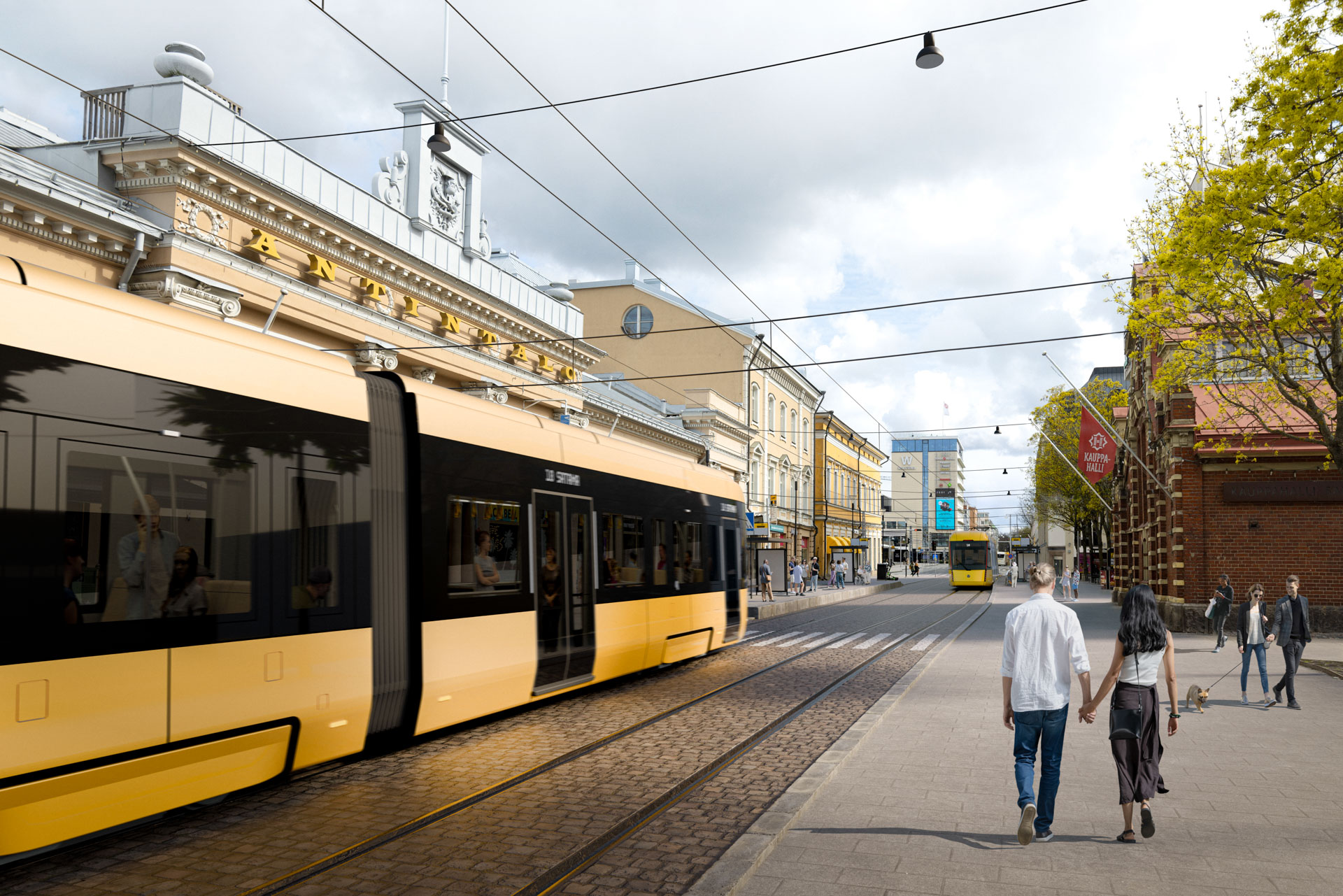
Turku has made one of the biggest Finnish urban-development decisions of the year. After years of planning, studies and political debate, the city council has approved the construction of a 12-kilometer tramline from the harbor to Varissuo via the city center and Kupittaa. The decision is still conditional on state funding, but politically this is a major step. Trams are expected to run in Turku in 2033.
For Turku, this is much more than a transport project. The tram gives the city a backbone for long-term sustainable urban development, in the same way light rail has done in many peer cities. The project also brings full street renewal along the route, including new cycle paths, pavements, green solutions and utility works. In other words, the tram is also a street-making project.
The politics were surprisingly tight. The final vote was 36–31, after a long council debate. That says something interesting about local urban politics. Turku removed its old trams in 1972, and the idea of bringing them back has been discussed throughout the 21st century. By now, there is plenty of evidence from other cities about how high-quality rail-based public transport can support urban growth, city-center accessibility and street renewal. Yet the decision still faced strong resistance. It is a reminder that cities do not automatically learn from one another, even when the lessons are visible nearby.
2. Odense turns the city center into a real-life testbed
Odense is taking a wonderfully practical approach to planning the future of its city center. Instead of beginning with a polished long-term plan and then asking people to react to it, the city is first testing ideas in real life. Over three months, around 70 temporary activities, changes and interventions will take place in Klaregade, Indre Rugårdsvej and Gråbrødrepassagen.
The idea is not just to animate the city center for the summer, although it will do that too. The city wants to use the experiments to understand what actually works before preparing a 10–15-year development plan for the city center. The three test areas represent different types of urban spaces, so the lessons should be useful beyond the individual sites.
This is lighter, quicker and cheaper urban development at an unusually ambitious scale. It treats temporary change not as decoration, but as a way of learning. In planning, we often rely on renderings to show people what a future place might look like. Odense is doing something more interesting: it is creating real-life renderings and asking people to experience them, react to them and help shape what comes next.
3. Malmö puts the “how” of city-center change on the table
Malmö’s new city-center strategy is not mainly about one street, square or building project. That is what makes it interesting. The strategy has reached the final political stage after a broad process involving municipal departments, businesses, property owners, culture actors, civil society and different groups of Malmö residents. Its aim is to create a shared direction for developing the city center as a sustainable, attractive, multifunctional and lively place for both Malmö residents and visitors.
The strategy touches many familiar city-center themes: public life, culture, business, meeting places, greenery, safety, accessibility and sustainable transport. But the most important layer may be governance. The future city center is not something one department can deliver alone. It requires coordination across municipal silos, clear priorities for public investment, and structured ways for the city, businesses, property owners, cultural actors and civil society to work together.
That is why Malmö is a useful case to follow. The strategy is designed to feed into future planning and municipal priorities, but also into committee-specific directions and cooperation contracts with actors in the city center. The real test will come after adoption. Can the strategy become a working platform for long-term transformation, or will it remain a good document? Either way, Malmö is putting the right question on the table. City-center development is not just design. It is also organization.
4. Riga’s Central Market crisis forces hard choices about a city-center anchor
Riga’s Central Market has become a reminder that city-center revitalization is not only about adding new attractions, redesigning public spaces or opening waterfronts. It is also about maintaining and rethinking the everyday institutions that already bring life into the center.
The immediate story is serious. The State Construction Control Bureau ordered the Meat Pavilion to close from 11 June because of structural safety concerns, including corrosion in load-bearing roof structures and other defects that had worsened over time. Traders had to be moved quickly, and although the city managed to find new spaces for most of them, the disruption exposed how fragile even a major central institution can become when difficult investment decisions are postponed.
The bigger story had already been building. The Meat Pavilion was expected to close in 2027 because of its technical condition, and Riga had been considering future uses for the building. The sudden closure simply brought the question forward. What should a historic market pavilion become when its old function no longer fits easily, but its role in the city center is still important?
This is the less glamorous side of city-center development. Maintaining central anchors is expensive, politically sensitive and easy to delay. But if cities wait until closure becomes unavoidable, they lose room to manage change carefully.
5. Tampere’s underground access dilemma goes deeper
Tampere is taking another major step in a long-running city-center strategy: moving more car traffic and parking underground so the surface city can become more people-oriented. Construction has started on the Yliopistontunneli, the first piece of a larger underground street and parking network. The first tunnel is expected to be completed in 2028, with a connection to an expanded P-Hämppi parking facility planned for 2031. In the longer term, the vision is a 2.5–3-kilometer underground street network that could allow traffic to pass beneath much of the city center.
On paper, the logic is clear. Tampere wants more housing, jobs, visitors and events in its center, but the narrow isthmus between the lakes has limited surface space. If car traffic and parking can be moved underground, streets above can be safer and more attractive for walking, cycling and urban life.
But this is also where Tampere becomes a more complicated story. I have written before about the city’s tendency to pursue a “cars and people” strategy, where expensive underground car infrastructure is justified as a way to create a better surface city. The question is whether the overall strategy is still looking clearly enough at the need to reduce driving, not just hide it.
Destination parking can have a role in a city center, especially when it is easy to reach and does not dominate the best public spaces. But every new tunnel and every new parking expansion also risks reinforcing the idea that more car access is always necessary. Before long, yesterday’s mobility system starts generating tomorrow’s “essential” infrastructure needs. Tampere’s underground network may help free surface space, but it also raises a harder question for city centers everywhere: who is making sure that solving today’s access problem does not lock in car dependency for decades?
Also on my radar
Warsaw — a benchmark for delivering city-center public space.
Warsaw is quickly becoming a not-to-be-missed benchmark for turning city-center public-space strategy into actual streets. The next major step is Krucza, a central street set to be narrowed and rebuilt with a green pedestrian boulevard, new trees, raised crossings and more room for everyday use. It is another piece of the New Center agenda becoming visible street by street.
Oulu – a fresh northern vision for the city center.
Oulu has approved its city-center vision for 2026–2040, built around the idea of a “delta city of northern rhythm.” The interesting part is how confidently the vision builds from Oulu’s own conditions. Water, the river delta, seasons, darkness and light, winter life, urban nature and a future-oriented northern identity all become part of the city-center story.
Tallinn — the center keeps filling in.
Tallinn has several central projects moving at once. The Central Market area plan has advanced, the old ERR buildings around Faehlmanni and Gonsiori are being prepared for a new residential and business quarter, and the Skoone bastion green-space competition adds another public-space piece near the Old Town.
Copenhagen — city life, parking and safer streets become one package.
Copenhagen has reached a broad agreement on parking, city life and safer streets after several street-space debates converged. The package adjusts underused electric car-sharing parking, restores selected business and disability parking, opens more room for outdoor serving, and prepares new green city-life streets and safe school routes. It shows how city-center street transformation is, in practice, a bundle of perspectives to balance: access, business needs, public life, climate adaptation, mobility habits and the quality of the spaces created when cars give way.
Stockholm — Centralstaden faces an uncertain future.
Stockholm’s Centralstaden megaproject has run into uncertainty after the Swedish government removed Tomteboda railyard works from the national infrastructure plan. The case shows how fragile large-scale infrastructure projects can be when local urban-development visions depend on national investment priorities.
Oslo — Oslo S high-rise confronts heritage concerns.
The Nye Oslo S plan has moved through public review, but the proposed high-rise at Jernbanetorget has drawn a formal objection from Norway’s heritage authority. The case touches upon a broader question for city centers: how can heritage, ecological values and everyday urban life be given equal weight when negotiating urban change?
Vilnius — Old Town street design sparks public reaction.
Vilnius is advancing street works on both Vokiečių Street and Trakų Street, but Vokiečių has become the more interesting public conversation. Critics argue that the emerging design feels too hard and paved for the Old Town setting, while the city has responded by explaining the project’s long design history, heritage logic, public-space concept and planned greenery.
Rostock — a smaller public-space test on Neuer Markt.
Rostock is using Neuer Markt as a summer test site for more greenery, shade and stay quality. It is not on the same scale as Odense’s city-center experiment, but it is a good example of using a central public space as a low-risk learning environment.
Uppsala — the city and businesses invite people to enjoy the summer center.
Uppsala is making a concerted push to become a livelier summer city, together with Uppsala Citysamverkan, local businesses and associations. The program includes more than 200 activities, most of them free, alongside upgrades to inner-city squares, parks and summer streets with more seating, greenery, flowers, art and outdoor serving.
Photo credit: Turun Raitiotieallianssi
Leave a Reply