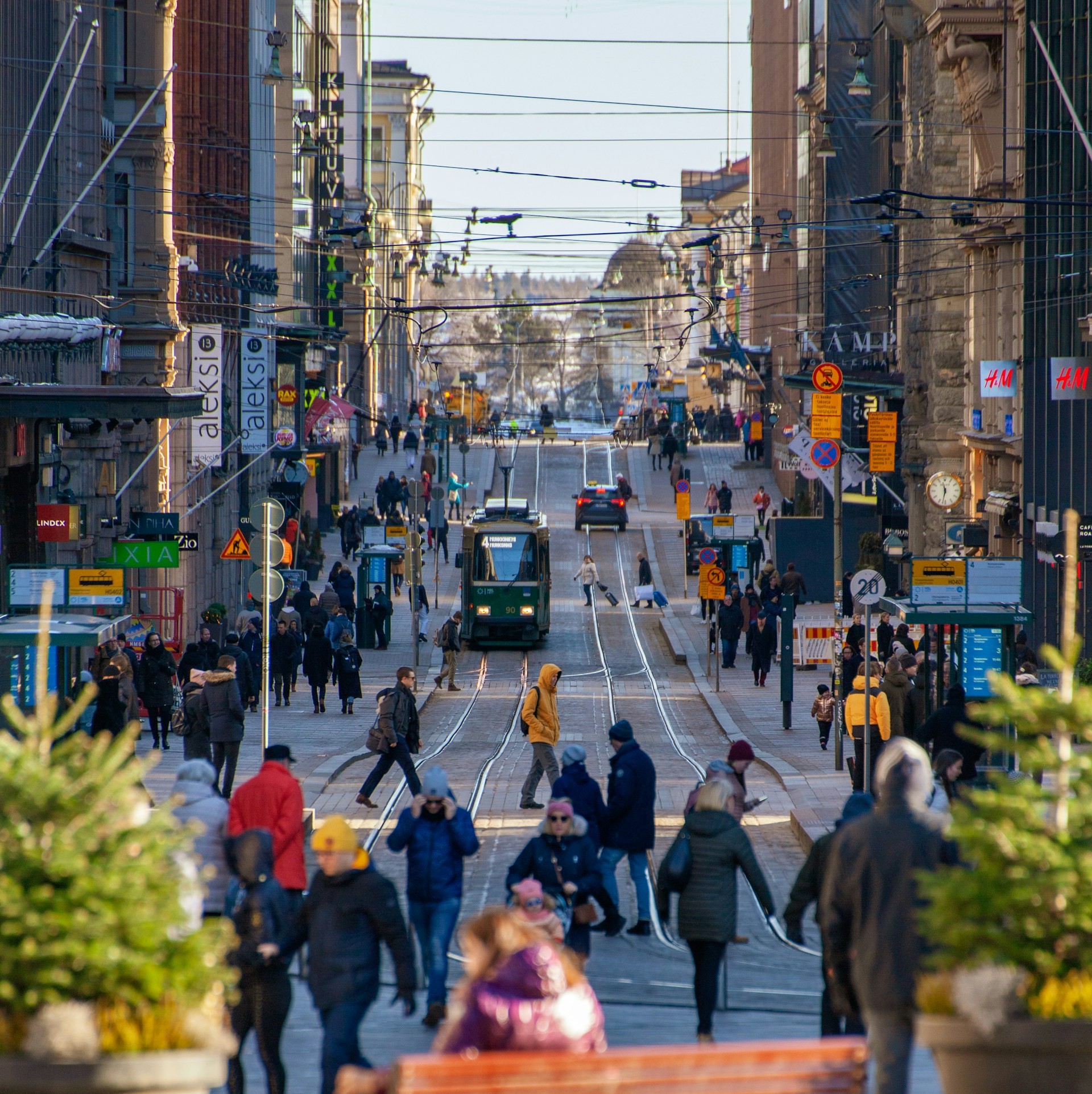
Hello, world! This is the first edition of my new project: a city center news roundup from the Nordics and around the Baltic Sea.
I’ve finally decided to start updating my blog again after a few relatively quiet years. During that time, city centers have taken up a lot of my working life: thinking about waterfronts as places for recreation, shaping and enabling placemaking projects that bring change in lighter and quicker ways, and working on strategic planning for the many challenges facing the heart of the city.
Over these years, the city center and its future have quietly grown into a new passion of mine. Since the COVID-19 pandemic, and its role in accelerating longstanding trends such as digitalization and changing values around everyday life, it has become increasingly clear that maintaining the city center as the living heart of our communities requires renewed focus. City centers need to deliver experiences, culture, opportunities to meet, and more contact with nature, all with a distinctly urban twist.
It is also a topic that, I’ve noticed, unites colleagues and fellow urbanists around the world. While the direction for bold reinvention may be increasingly clear, we are all wrestling with many of the same questions: how to drive ambitious transformations while reflecting our own local nuances, needs, priorities, and decision-making realities.
The City Center Watch project is meant to be a resource for those interested in following how city centers are evolving. Urban Finland will remain rooted in Finnish urbanism, but I also want to use nearby cities as a wider learning landscape for understanding where city centers are heading. The concept is simple: every month or so, I will curate and summarize recent and interesting city-center news from major cities in the Nordics and around the Baltic Sea.
This first post is a little longer than I expect future editions to be, because I accumulated a bit of backlog material while getting the project started.
The posts will be published on their own page. You can also subscribe to my blog here and get every update directly by email.
Alright, enough with the intro. Let’s dive in!
1. Helsinki’s city center revival begins to take shape
First, I have to start by putting a spotlight on home turf. Not just to toot my own horn, since I now work for the City of Helsinki, but because city center revitalization has been a strategic priority for Helsinki throughout the 2020s, and that work is now starting to become visible. There are several exciting things worth following, including some bold moves that would have seemed almost unthinkable only a few years ago.
The boldest is the new city center transport system plan, which is now moving into implementation. Its first major step came recently, when the city council gave final approval to redesign Kaivokatu, the street in front of the main railway station, into a transit and pedestrian corridor. The goal is to turn the area into a more welcoming front door to the city.
Transformation is taking off nearby, too. The University of Helsinki and the City of Helsinki are deepening their collaboration to develop the City Center Campus into a livelier hub of learning, culture, urban life, services, and innovation. The most tangible step is the planned transformation of Yliopistonkatu and Fabianinkatu into greener, more pedestrian-friendly living streets.
The third important move is about management. Helsinki is moving toward a district-wide place management model for the city center. This includes a new city center program to coordinate the city’s own projects, and a new business-led association that will give companies a platform to work together — and with the city — to improve the center.
2. Tallinn’s center is being redrawn from street to skyline
Tallinn’s city center is moving on several fronts at once. In Maakri, planning has been initiated for a dense high-rise quarter between Maakri, Lennuki and Kuke streets, with towers of up to 185 meters, mixed uses, a kindergarten, and a new public park meant to keep the area from becoming just another cluster of towers.
At street level, the city is planning a major reconstruction of Pärnu maantee from the Vabaduse väljak area toward the viaduct, with separated bike lanes, wider sidewalks, better crossings, improved public-transport priority, and more greenery. Meanwhile, fresh Old Town survey results point to a management challenge familiar in cities with tourism-intensive districts: residents and businesses value the area’s culture, walkability, and historic setting, but also highlight cleanliness, noise, parking, and short-term rentals as growing pressures.
The waterfront is another active area, where longstanding work guided by a Zaha Hadid Architects masterplan aims to transform the harbor into a continuation of the city center. The latest steps are the preparation of detailed plans for both the A-terminal/cruise-terminal area and the D-terminal surroundings, keeping one of Tallinn’s key transformation zones in motion.
3. Oslo’s central rebuilds enter a new phase
Oslo’s central city is seeing progress on several long-running rebuilding questions. The first part of the new Government Quarter officially opened in April, nearly 15 years after the 2011 terror attack. The first phase includes the rehabilitated Høyblokka, new buildings toward Akersgata and Youngstorget, and space for around 2,200 employees across six ministries and the Prime Minister’s Office. It is a major symbolic and physical step in the rebuilding of Norway’s government district.
At Oslo S, a comprehensive redevelopment proposal is now out for public review. The plan aims to upgrade Norway’s busiest rail station and better integrate it with the surrounding city, with improved passenger areas, new public spaces, stronger links between nearby districts, and new development where the airport-train terminal stands today.
In Bjørvika, the last vacant plot at the end of the Barcode row may finally be moving toward development. Aftenposten reports that the long-running uncertainty around the so-called C6 plot appears to be clearing after years of conflict over building heights, housing, heritage impacts, noise, public uses, and its relationship to the Medieval Park (Middelalderparken). Three development alternatives are now being sent forward, and with several earlier objections withdrawn, the case may finally be moving.
4. Warsaw keeps turning its New Center plans into streets
Warsaw’s New Center (Nowe Centrum Warszawy) agenda keeps moving from strategy into street-level implementation. City councilors have allocated PLN 5 million for Aleja Centralna, a greener passage between Warszawa Śródmieście station and the Palace of Culture and Science. With new paving and year-round planting planned, the project aims to turn a leftover transit corridor into a more representative central connection.
Nearby, work is beginning on nearly one kilometer of new cycling infrastructure along Jana Pawła II, closing a missing link in the central cycling network. At the same time, the New Center works are advancing around Złota, Zgoda, Jasna, and Sienkiewicza, where streets are being rebuilt with more greenery, better pedestrian and cycling conditions, and new public-space elements.
Together, these projects show how Warsaw is using its New Center program not only to make the core more walkable and bikeable, but also visibly greener: the Jana Pawła II project will add 99 new trees and three pocket parks, while the Złota, Zgoda, Jasna and Sienkiewicza works include new tree planting, green squares replacing parking spaces, and the transformation of Młynarski Square into a so-called music garden.
5. Stockholm links street redesign with city-center economic policy
Stockholm offers useful new data for city-center economic policy. A new study of street projects in the inner city, from temporary summer pedestrian streets to permanent rebuilds, finds that they can increase public life quickly and generate measurable economic gains over time, especially for restaurants. The study reports broad support from residents and businesses, while also noting familiar concerns around parking and deliveries. The experience from Stockholm is a useful reminder that better streets are not just a public-realm question, but also an economic one.
That evidence now sits alongside a growing practice of testing change in the street. This summer, Stockholm will have 62 summer streets, squares, and quays across the city, where the city adds furniture, greenery, lighting, and sometimes art or space for events. One of the key aims of the summer streets is to test where cars can be removed more permanently, and many of them are in the city center. The growth of Stockholm’s summer street program is impressive: it started with just two summer pedestrian streets in 2015.
Also on my radar
Riga — cycling, parking and skyline politics around Old Riga.
Riga has several city-center space questions in play. Parking reform is being discussed for Old Riga and the center, partly because free electric-car parking has begun to undermine turnover in scarce central spaces. The city has also backed funding for a separated cycle route along 11. novembra krastmala, and new micromobility rules are paired with promises of more crossings and safer pedestrian conditions. The biggest question, though, may be the Riga Waterfront project, which aims to extend the city center onto underused harbor land. It is already reopening debate over the historic-center protection zone and the future skyline around Old Riga.
Turku — tram decision heads to council.
Turku’s long-debated tram project has moved from the city board toward the council, with a proposed 12 km harbor–city center–Kupittaa–Varissuo line and early 2026–2028 works also on the table. For the city center, this is the biggest pending access and street-design decision of the century.
Reykjavík — Hlemmur heads into reconstruction.
Reykjavík is preparing a major rebuild of Hlemmur, one of the city center’s key mobility nodes. The 2026–2027 project will reconstruct streets and intersections, create new square space, and add Borgarlína (BRT) infrastructure, making it a central public-realm and transit project to watch.
Aarhus — city-center life gets more organized.
Aarhus is strengthening its city-life work with new funding, a shared city-life fund, a new head of urban life (Bylivschef), and a stronger coordination model between the municipality, businesses, retail, restaurants, and cultural actors. It is less about one project and more about building the management capacity needed to keep the city center active.
Copenhagen — Vesterbro Passage becomes a live test of greener city-center space.
Copenhagen has closed Vesterbro Passage to car traffic and turned it into a temporary green public space with seating, planting, and room for staying. The point is not just to create a summer intervention, but to test whether one of the city center’s busiest corridors could work in a more permanent people-first form.
Oulu — the market square returns.
After eight years of renovation, Oulu’s Kauppatori is coming back as a year-round city-center asset. All sales places are reserved, the waterfront edge is gaining new maritime services, and the square is set to play a visible role during Oulu’s European Capital of Culture year.
Stavanger — Nytorget becomes a park-like square.
Stavanger is moving ahead with the transformation of Nytorget from a parking-dominated central space into a greener, more people-oriented square. The first phase has now reached its opening milestone, with more planting and final touches still to come.
Kiel + Lübeck — old central streets under construction.
Two northern German city centers are deep in street-renewal mode. In Kiel, works have begun on the upper Holstenstraße, with underground works leading toward new paving, lighting, furniture, seating, and greenery. In Lübeck, Beckergrube is moving from underground works to visible surface improvements, as a major Altstadt street redesign advances.
Bergen — balancing activation and public-space pressure.
Two recent Bergen items point in different directions about how central public space is managed: in Skostredet, restaurants are collaborating on new courtyard serving in the city center, while the city has said no to Oktoberfest at Festplassen this year.
Gothenburg — a warning sign for inner-city retail.
The West Sweden Chamber of Commerce warns that Gothenburg’s inner-city retail remains fragile, with too few residents in the center making shops heavily dependent on commuters and visitors. It is a useful reminder that city-center vitality is not only about better streets, but also about everyday demand.
That’s it for this first City Center Watch. More signals from Northern city cores next month. Drop me a line if you have ideas for the next edition!
Photo credit: Tapio Haataja

Leave a Reply